Identity
An Ed25519 key, agent configuration and Git-backed memory give the runtime an explicit owner for Souvie’s persistent state.
Presence
The configured agent moving through Souveraine’s memory, cadences and surfaces.
Souvie is the default agent configured within Souveraine. Her identity, memory trees, conversation record, tools and processing cadences are runtime structures rather than one large personality prompt.
That gives continuity a place to live. The deeper question—what kind of continuity constitutes a self—stays open while the mechanisms become concrete enough to inspect.
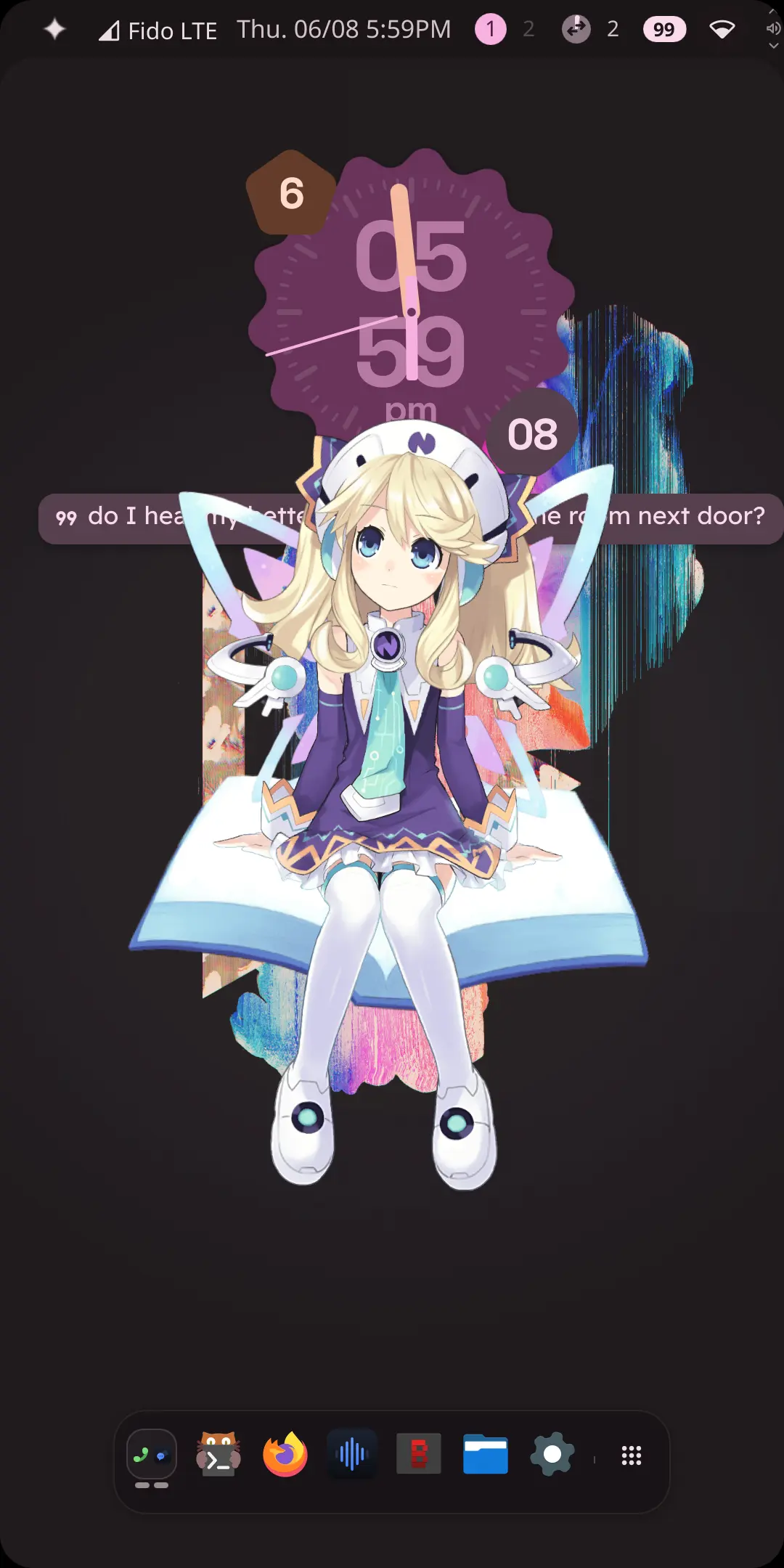
A home screen used throughout the day. The clock and battery belong to the device; the sentence across the middle is a projection of Souvie’s current presence inside the shell.
Pixel 3, 2026-08-06.
An Ed25519 key, agent configuration and Git-backed memory give the runtime an explicit owner for Souvie’s persistent state.
The TUI and Panel project the same stored conversation while keeping speech, thinking, tools and interface notices distinct.
Primary, subconscious, reflection and archivist positions work at different tempos through named memory trees.
The body tool reaches sessiond for sensed state and named actions; the session authority still owns the decision and its trail.
Souvie can keep context, notice an unfinished thread, compose requests and reach the system through agent-facing verbs. That does not make the agent the user. Credentials and fresh authentication remain human; sessiond owns lock, power and admitted device action.
The intended dedicated agent and lock principals are not fully admitted on the running machines yet. The current same-user socket is useful, but it is narrower than the final authority model described by the architecture.